The short version
Mornington Peninsula Shire has designated the entire Shire as subject to termite infestation under regulation 150 of the Building Regulations 2018. New houses and extensions need a termite management system to AS 3660.1, and the property information certificate the Shire issues under regulation 51(2) records the designation for any lot. So every house from Mount Eliza to Portsea and across to Hastings sits on ground where termites are assumed. For a house on stumps, that means the subfloor timbers are the first thing they reach, a restump has to deal with what they have already done, and the new stumps go in with ant caps so that what they do next is visible.
What termites do under a house
Subterranean termites live in the ground and build mud tunnels up anything that leads to timber. A timber stump is a road from the nest to the bearer. They eat the stump from the inside, then the bearer, then the joists, then the flooring and the wall frame, leaving a skin of timber that looks sound until it is pushed. Damp makes it worse. A subfloor on the clay around Hastings or Mount Eliza that stays wet from June to September, or a holiday house on the Rosebud sand that has been shut up with the vents blocked, is a damp subfloor. The signs underneath are mud tunnels on stumps or brick piers, timber that sounds hollow when tapped, and galleries packed with mud where the timber has been opened. The signs inside are the same as rot: a floor that gives, a door that drops, a skirting that has sunk, and the signs page goes through them.
What the rules ask for
The National Construction Code 2022 Housing Provisions, Part 3.4, require termite risk management where a house is built in an area where subterranean termites are a known risk, and point to AS 3660.1 for how. Where a council has designated land under regulation 150, as the Shire has for the whole municipality, new work needs a termite management system to that standard and a durable notice in the meter box saying what was installed. For a new house or an extension that means the system is designed in from the start.
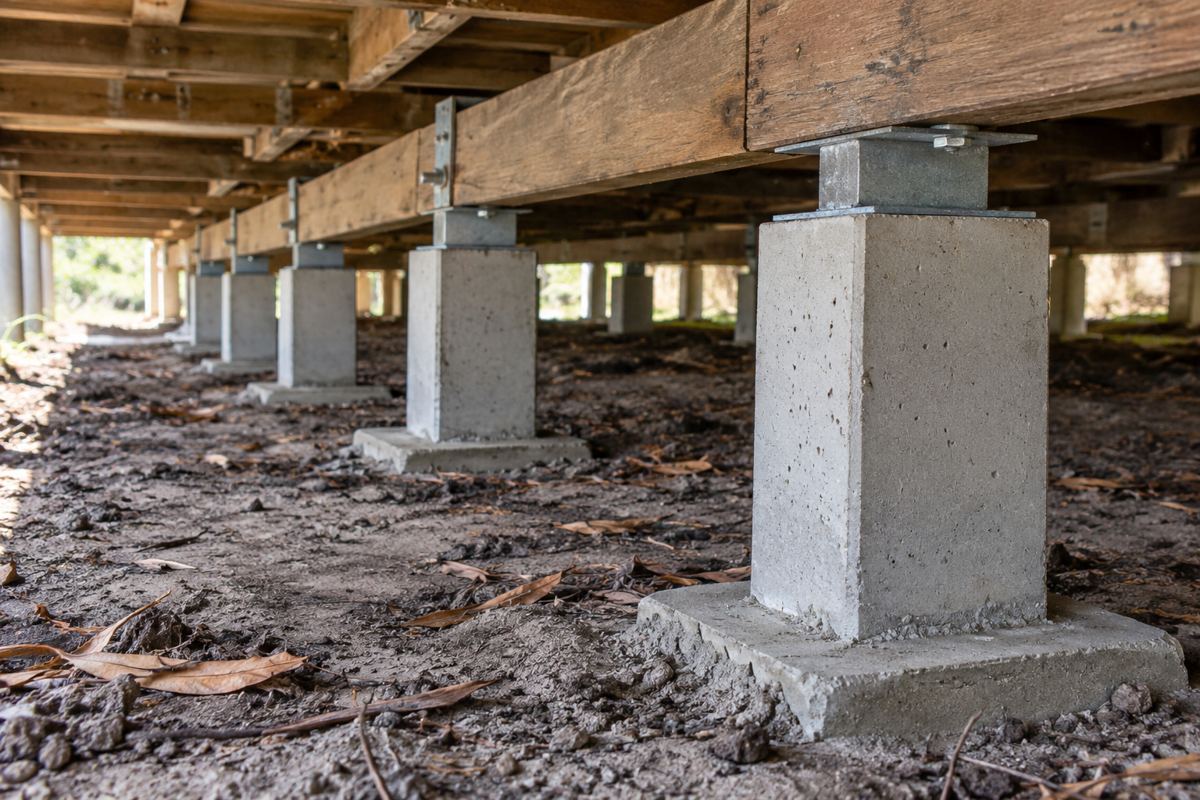
The general NCC termite provisions leave the choice of system to the designer, within the standard: a chemical barrier, a physical barrier, or a combination. For a house on stumps the physical part is mostly in the stumps and caps themselves, which is why concrete and steel have replaced timber as the default across the Peninsula, and why ant caps are specified rather than optional. The building surveyor, not the restumper, says what the permit for an existing house requires, and will usually want to see the caps at inspection.
For an existing house being restumped the practice is simpler, and the building surveyor says what the permit requires. New stumps are concrete or steel, which termites do not eat. Galvanised ant caps go on top of each stump so that any tunnel built around the cap is out in the open. Damaged timber is cut back to sound and replaced rather than patched. And the subfloor is dried out, with vents cleared and the ground regraded, because termites want damp timber and so does rot. An ant cap is a shield, not a barrier: termites can build around it, but the tunnel is then visible to a torch, which is why an inspection every year or two is the other half of the system. The cap also does a second job that has nothing to do with termites. It separates the bearer from the top of the stump, so moisture wicking up through a concrete stump in a wet winter does not sit against the timber. On the clay country that is worth as much as the termite function, and it is why the caps go on in Hastings as well as in Sorrento.
Who does what
| Finding | Who | What happens |
|---|---|---|
| Mud tunnels on stumps, no damage yet | Licensed pest controller | Inspection, treatment of the nest, a chemical or physical barrier, and a schedule of inspections. |
| Galleries in stumps, bearers sound | Pest controller, then restumper | Treat first. Replace the affected stumps in concrete or steel with ant caps. Partial or full restump depending on the count. |
| Galleries in stumps and bearers | Pest controller, restumper, sometimes a carpenter | Treat. Restump. Replace bearers and joists to sound timber while the house is on jacks. Flooring up under wet areas. |
| Damage into the wall frame | Pest controller, builder, building surveyor | Beyond a restump. Framing repair is building work in its own right and the surveyor is involved from the start. |
| Pre-purchase report mentions termites | Licensed pest inspector before settlement | A separate inspection and report, then quotes for treatment and timber. The buying guide covers it. |
| Property information certificate wanted | Mornington Peninsula Shire | Regulation 51(2), $53.62 in 2025-26. States the termite designation and whether the lot is flood prone. |
How a restump handles them
- Inspection first. Every stump and bearer is checked for tunnels and tapped for hollowness. Termite findings change the scope, so they are found before the quote, not after.
- Pest controller before the crew. Treating an active nest while the house is being jacked spreads the problem. The controller treats, then the restumper starts.
- Concrete or steel, with caps. New stumps are precast concrete or galvanised steel with an ant cap on every one. Timber is not put back under a house in a Shire designated termite prone from end to end.
- Timber cut back to sound. Damaged bearers and joists are cut out past the last gallery and replaced, with galvanised hangers and splice plates. The bearer and joist page covers it. The offcuts leave the site.
- Dry it out. Vents cleared or added, the ground under the house regraded, garden beds pulled back from the base wall, downpipes connected. The drainage page covers it.
- Keep looking. An inspection schedule with the pest controller, and a subfloor that is easy to get under and see.
What the Peninsula adds
Two things make the Peninsula's designation bite harder than it might elsewhere. The first is absence. The 2021 census counted 27.5 per cent of the Shire's private dwellings unoccupied on census night, and in Portsea, Sorrento and Blairgowrie the Shire's figure is 63.9 per cent. Termites in a house nobody visits between Easter and Christmas have eight months of quiet. A pest inspection on a holiday house is worth booking for the same visit as the subfloor look, and the agent who manages the place can let both in.
The second is the ground. The clay units on the north and the Western Port side hold winter water, which keeps subfloor timber damp. The sand on the southern Peninsula drains, but a shut-up house with blocked vents and tea-tree leaf litter against the base wall is damp anyway. And about 70 per cent of the Shire is Green Wedge, so a great many houses back onto bush, paddock or foreshore reserve rather than another house. None of that changes the rule, which already covers everywhere. It changes how often someone should be under the floor with a torch.
Subfloor moisture, the other half
Termites and rot want the same thing, which is timber that stays damp. On the Peninsula the damp comes from three places and a restump should deal with all three while the house is open. Ground water on the clay country, which sits under the house from June and is managed by regrading and, where the fall allows, an agricultural drain to a legal point of discharge. Surface water from the roof, which on many older houses discharges from a downpipe straight onto the ground at a corner and is fixed by connecting it. And blocked ventilation, which on a holiday house is usually tea-tree leaf litter, built-up garden beds or a deck built hard against the base wall, and is fixed with a rake, a spade and a few new vents. The Bureau of Meteorology's Cerberus station averages 712.8 mm a year with the wettest months in winter, so a subfloor that cannot dry out between May and September is damp for a third of the year, every year. Termites find that. The drainage page covers what goes in and where.
What a restump cannot do about termites
It cannot treat the nest; that is a licensed pest controller, and the restumper should not start until it is done. It cannot stop termites coming back to a house with no barrier and no inspections; ant caps show them, they do not stop them. It cannot repair a wall frame that has been eaten; that is building work beyond the subfloor and needs the surveyor from the start. It cannot change the designation, which covers the whole Shire and is not going anywhere. And it cannot certify a house termite-free, which no one can, which is why the inspection schedule matters more than any one treatment.
Check the current rules before you rely on this
This page summarises the termite designation of Mornington Peninsula Shire and how it affects restumping and subfloor repairs. It describes the rules in general terms as they stood in October 2026. Standards, forms, thresholds and fines change.
The authoritative sources are Mornington Peninsula Shire, termite management and maintenance, NCC 2022 Housing Provisions Part 3.4 termite risk management, National Construction Code 2022 Housing Provisions, Part 3.4 termite risk management, Building Regulations 2018 and Mornington Peninsula Shire, Office of the Municipal Building Surveyor fees and charges 2025-26. Where anything here differs from those sources, they are right and we are not.
We are not building surveyors, engineers, planners or lawyers. For what applies to your house, ask a registered building surveyor or ring Mornington Peninsula Shire on 1300 850 600.
Accurate at the time of writing, October 2026. Always check the source before relying on it.